Welcome to Henan Mine Crane Co.,Ltd.
In many shops, time slips away on small lifts. A worker moves a motor onto a bench. Another worker sets a welded part into a fixture. One lift feels simple. But many lifts each shift can slow the station and wear people down.
A jib crane helps because it brings lifting right to the job. It is common for workstation handling. A KBK crane system often fits flexible workstation tasks instead.
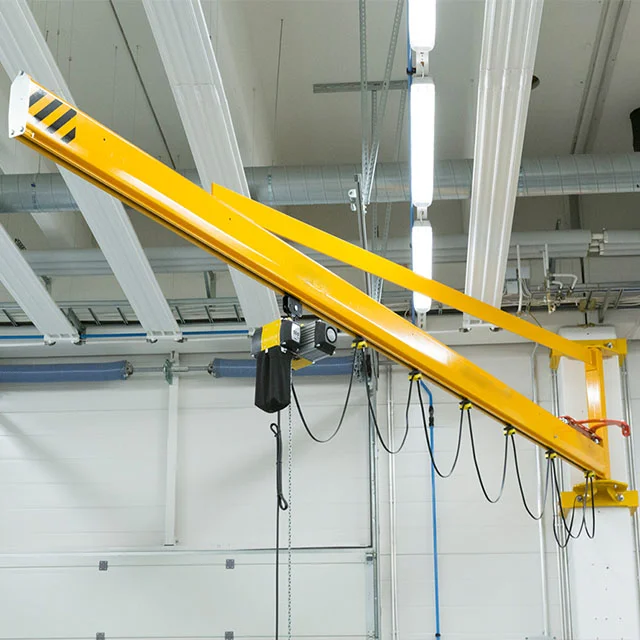
Start with the floor, not the catalog. Where does the load begin? Where must it land? Can the boom swing past machines, carts, shelves, or guardrails?
A freestanding jib crane fits an open work area. A wall-mounted jib crane saves floor space. If the arm fails to reach the pallet center, the operator still faces a problem, even when the drawing looks fine.
A workstation jib crane must lift and place parts with care. This matters for painted, machined, or easy-to-dent parts.
Useful parts include a hoist, trolley, control cabinet, remote controller, overload limiter, limit switch, hook assembly, and emergency stop system. These parts let the operator move the load with less risk and less guesswork.
Jib crane selection should begin with the real job. Check the heaviest load, lifting height, working radius, lift count per hour, and space around the worker. Crane quotation guidance also lists capacity, span or reach, lifting height, duty class, power supply, control method, and working environment as key details.
A good choice should fit the shop floor. It must not prove too weak. It must not prove too large. It must not prove hard to use.
Do not count only the part weight. If the part weighs 800 kg and the clamp adds 120 kg, the real load becomes 920 kg. That changes jib crane capacity.
The jib crane working radius also needs a clear check. A long arm may need stronger support and more swing space. In a small work cell, just enough reach is often better.
A freestanding jib crane works well where the floor can take anchors and a base. A wall-mounted jib crane helps when the floor is crowded. A portable jib crane can suit light-duty work or changing layouts.
An articulating jib crane bends around posts, bins, and machine guards. In a CNC area, this can turn an awkward lift into a smoother one.
Duty class shows how hard the crane works. A crane used twice a week differs from one used every few minutes.
A3 to A4 is often used for light-duty work. A5 to A6 fits medium duty. A7 to A8 suits heavy continuous work. If lifting stays frequent, choose the hoist, brake, and structure for that pace.
Jib crane setup is where small mistakes become daily trouble. The hook may stop short. The boom may hit a column. The worker may walk around a cart every time.
Before installation, mark the work area on the floor. Then walk through one real lift. This simple check can save time later.
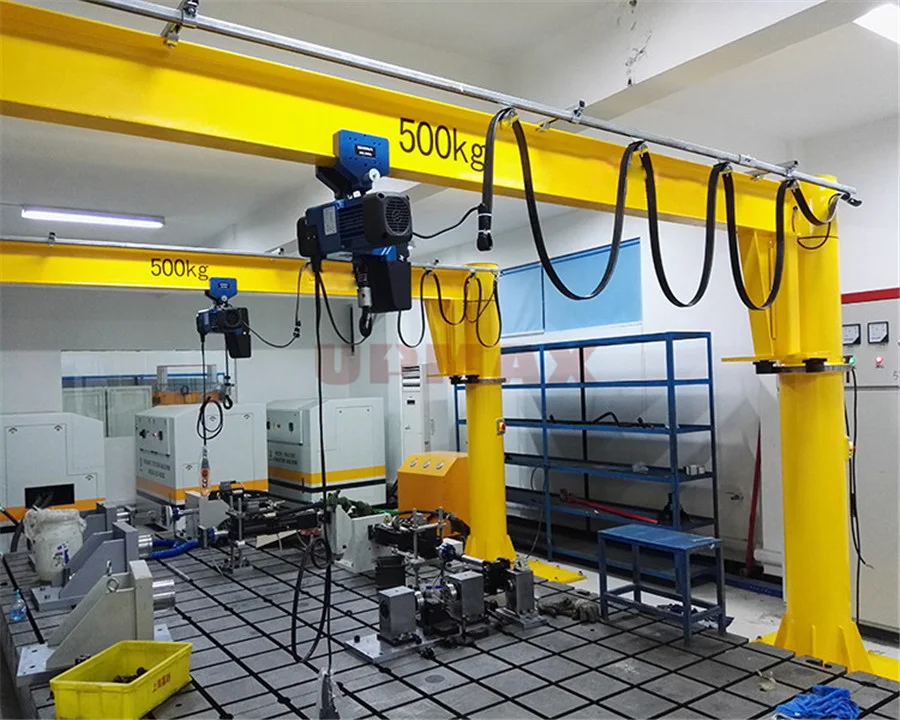
For a pillar jib crane, check the floor and foundation. For a wall-mounted jib crane, check the wall or steel column. The support must carry the load safely.
Also check anchor bolts, the base plate, rotation parts, and nearby building members. Moving a crane later is never fun.
Hook coverage should match the pickup and drop points. Keep the load path short and clear. If forklifts pass nearby, set safety zones or rotation stops.
The worker should not need extra steps just to use the crane. A good jib crane setup should feel natural.
Pendant control is simple and common. Wireless remote control helps when the worker needs distance from the load. VFD control gives smoother speed for gentle handling.
Choose controls for the person using the crane, not only for the price list.
KUANGYUAN serves factories, warehouses, workshops, and heavy industrial sites with cranes, hoists, and related lifting systems. For a workstation project, this matters because a standard crane may not fit every site. You may need a special arm length, different voltage, low headroom design, corrosion protection, or remote technical support. A practical supplier should ask about your load, site, work cycle, and layout before giving a solution. That is how a jib crane becomes a useful shop-floor tool, not just a piece of steel.
Customization should fix a real issue. If a straight boom cannot reach around a machine guard, an articulating jib crane may help. If floor space is tight, a wall-mounted jib crane may be cleaner.
Do not add features because they sound advanced. Add them when they make the job safer, quicker, or easier.
A jib crane needs steady care. Daily checks should cover the hook, chain or wire rope, controls, bolts, and unusual noise. Monthly checks can cover lubrication and fasteners. Larger checks should review the brake, electrical parts, and full lifting system.
A common maintenance plan includes daily visual checks, monthly lubrication and fastener checks, quarterly electrical checks, and a yearly full inspection.
Training works best at the station. Workers should know rated load, side-pull risks, safe hook position, and emergency stop use.
A short hands-on session can stop bad habits early.
Jib crane safety affects speed. When the load path is clear and the crane moves smoothly, workers hesitate less.
That is where workstation efficiency shows up: fewer delays, fewer awkward moves, and a calmer work area.
Q1: What Is the Most Important Factor in Jib Crane Selection?
A: The real lifting task matters most. Check load weight, working radius, lifting height, duty class, and site layout.
Q2: What Is the Difference Between Jib Crane Selection and Jib Crane Setup?
A: Jib crane selection means choosing the type, capacity, reach, hoist, and controls. Jib crane setup means placing, mounting, testing, and preparing the crane for daily use.
Q3: Which Jib Crane Is Best for Limited Floor Space?
A: A wall-mounted jib crane is often a good choice because it keeps the floor clear. The wall or column must still be strong enough.
Q4: Can a Jib Crane Improve Workstation Efficiency?
A: Yes. It can reduce hand lifting, shorten moving time, improve load placement, and lower worker fatigue.
Q5: What Should Be Checked Before Installation?
A: Check floor or wall strength, anchors, hook coverage, rotation range, power supply, nearby obstacles, and the operator’s walking path.
 Whatsapp