Welcome to Henan Mine Crane Co.,Ltd.
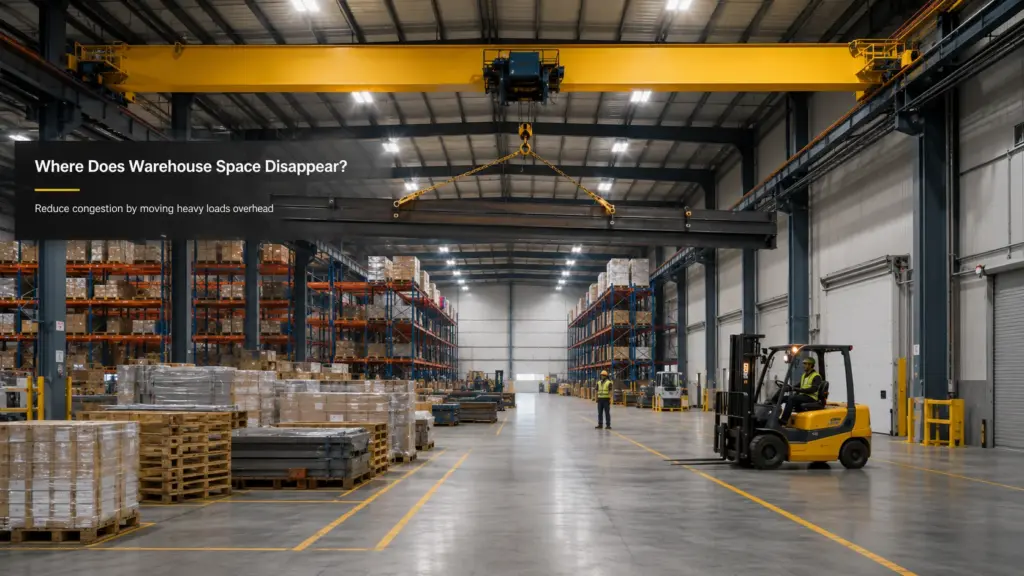
An Overhead Crane can give crowded warehouse floors room to work. You move selected heavy loads above storage, production, and packing zones instead of through forklift aisles. The result is a cleaner route, fewer set down points, and more productive floor space. The right layout starts with your loads and building.
Congestion may look like a storage problem, yet material movement is often the cause. Turning areas, buffers, and repeated handoffs take space. Trace one load from receiving to dispatch and mark every stop. This exposes the places worth fixing first.
Forklifts need lanes, turning room, pedestrian separation, and pickup space. A properly placed Overhead Crane system can carry heavy or awkward items across a bay while forklifts handle flexible routes elsewhere. The goal is to assign each movement to equipment that uses space well.
A high roof does not automatically create useful vertical space. Trusses, lights, sprinklers, ducts, girders, and the hoist affect the highest hook position. Wall clearance and trolley approach also create dead zones. A compact Bridge Crane must still reach the actual pickup and placement points.
An Overhead Crane or Bridge Crane covers a rectangular area through bridge, trolley, and hoist motion. It can connect receiving, storage, processing, and packing without another floor vehicle on the main route. The largest gains usually come from repeat moves involving long, heavy, or fragile loads.
Top running designs can suit higher capacities or longer spans when the structure supports them. Underhung systems may fit lighter work. A low headroom Electric Hoist can bring the hook closer to its support and preserve lifting height. A structural professional still needs to check runway reactions, columns, foundations, and local rules.
Coverage should follow the job sequence. If a load still goes onto the floor between two systems, the layout has moved the bottleneck. Check the load envelope, attachment, swing allowance, and operator view at each pickup and drop point. Corners deserve special attention. Neat drawings often meet awkward reality there.
One machine rarely serves every movement well. Divide the site into full bay routes, local cells, fixed transfer paths, and outdoor links. Choose equipment from the task backward, considering frequency, accuracy, floor access, and future rack changes.
| Equipment | Suitable Use | Space Consideration |
| Overhead Crane / Bridge Crane | Repeated lifting across a warehouse bay | Keeps the main load route above the floor |
| Electric Hoist | Vertical lifting on a bridge, monorail, or fixed beam | Compact, but coverage depends on its support |
| Jib Crane | Machine loading, maintenance, and packing cells | Gives local coverage without a full runway |
| Gantry Crane | Buildings that cannot support a runway, plus indoor to outdoor work | Legs and wheel paths occupy floor space |
| Transfer Cart | Repeat movement between fixed stations or crane bays | Reduces forklift handoffs but needs a protected route |
| Winch Machine | Pulling along a defined line | Useful for a narrow task, not full bay coverage |
A Transfer Cart can link production zones when overhead coverage cannot cross a doorway or building joint. A Rubber Tyred Gantry Crane and Portal Crane usually suit yards, container areas, and ports, so either may waste space inside a tight warehouse.
Capacity alone cannot define a reliable system. Give suppliers the same site drawing and load schedule, then compare coverage, exclusions, and responsibilities.
List normal and maximum weights, dimensions, lifting points, center of gravity, and attachment needs. Add lifts per hour, travel distance, shift pattern, and placement accuracy. Long items may need a spreader beam. Fragile goods may benefit more from smooth starts than higher speed.
Record clear height, bay width, column spacing, runway elevation, doors, racks, utilities, fire protection, and maintenance access. Mark people, forklifts, and loading points on the same drawing. Add planned racks or machines so today's crane does not become tomorrow's obstruction.
Compare the present and proposed routes over the same period. Include structural work, power, installation, commissioning, inspection, training, maintenance, and planned downtime, not just purchase price.
Track floor area released, forklift trips removed, handoffs avoided, cycle time, labor, and damage risk. Exclude areas that must remain clear for operation or service. Use ranges where data is uncertain. An estimate tied to your floor plan beats an impressive percentage with no basis.
Henan Mine Crane Co., Ltd. designs, manufactures, and sells bridge cranes, gantry cranes, electric hoists, and related parts. Its official information also describes custom material handling solutions, turnkey delivery, staff training, and after sales support. That range matters when a warehouse needs a main crane plus a local hoist or ground transfer system. The company reports more than 2,000 sets of processing equipment and the ability to complete over 20 machining processes in house. These capabilities are relevant when span, lifting height, duty, controls, or attachment needs differ from a standard package. Bring a building section, load list, route drawing, and operating schedule to the first discussion. This gives the supplier enough context to shape an Overhead Crane proposal around the work.
Q1: What Is the Main Space Benefit of an Overhead Crane?
A: It moves selected heavy loads above the floor, reducing some forklift lanes, turning areas, and staging. The net gain depends on the layout and safety clearances.
Q2: Can a Bridge Crane Work in a Low Warehouse?
A: Sometimes. A low headroom hoist can preserve hook height, but roof structure, utilities, runway level, and load height must be checked.
Q3: When Is a Jib Crane Better Than a Full Bay Crane?
A: A Jib Crane often fits one machine, maintenance point, or packing cell where local rotation covers the task.
Q4: Should a Gantry Crane Be Used Indoors?
A: It can work indoors when the building cannot support a runway. Include its legs, wheel path, and floor or foundation needs in the space study.
Q5: What Information Should Be Sent for a Crane Quote?
A: Send load weights and sizes, lifting frequency, route, building drawings, clear height, runway details, site conditions, control needs, and expansion plans.
 Whatsapp