Welcome to Henan Mine Crane Co.,Ltd.
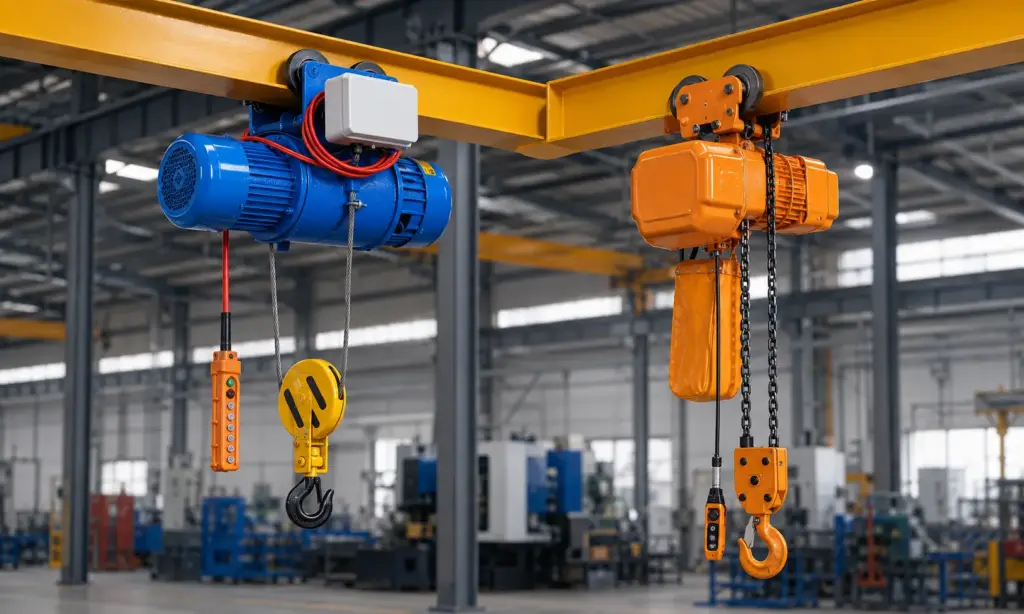
Direct answer: Choose a wire rope hoist when the lifting task calls for a drum-and-reeving system, longer lift, broader travel integration, or a verified higher-duty configuration. Choose an electric chain hoist when a compact body, simpler load path, modest lifting task, and accessible chain inspection fit the job.
Neither type is automatically better. The right answer comes from the load, lift height, duty cycle, headroom, travel arrangement, positioning need, and maintenance plan.
Buyers often ask for a hoist type before the operating data is complete. A reliable inquiry begins with the load, frequency, hook reach, and safe inspection access.
At KUANGYUAN, we manufacture electric hoists and lifting equipment. We treat the hoist as one part of the lifting system. The supporting beam, trolley, controls, power supply, environment, and inspection access affect the final configuration.
Write down the rated load, typical load, lift height, lifts per hour, operating hours per shift, required travel, available headroom, hook approach, power supply, and environment. Add any need for slow positioning, variable speed, outdoor protection, or special controls.
This information matters more than a generic capacity claim. Our registered product data contains wire rope and chain hoist families with overlapping rated-load and lifting-height ranges. That overlap is exactly why a buyer should not select by one number alone.
The final model limits and operating class must come from the approved quotation and technical sheet.
If the hoist will run on a complete crane, define the crane duty and building constraints as well. Our industrial crane selection guide explains the wider lifting-system inputs.
A wire rope hoist winds steel wire rope onto a drum. The rope may pass through a reeving arrangement before reaching the hook block. Drum condition, rope winding, rope guide behavior, sheaves, reeving, and the hook block all belong in the inspection path.
An electric chain hoist moves a calibrated load chain over a pocket wheel. The chain passes through the hoist body, supports the hook, and normally collects in a chain container on the slack side.
The load chain, pocket wheel, guides, chain container, hook, and brake form a different inspection path.
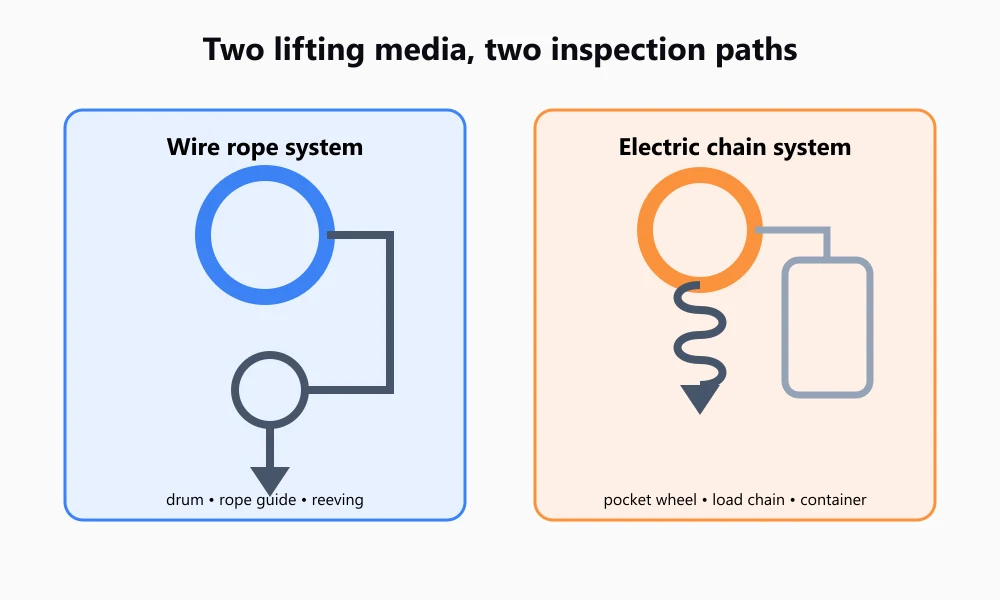
These mechanisms should never be described as two versions of the same load path. Rope reeving affects how the hook block moves and how the rope winds on the drum. Chain articulation and pocket-wheel engagement create their own wear pattern.
Maintenance instructions and discard criteria must follow the selected manufacturer documentation.
Start with the real load spectrum rather than the heaviest item alone. A hoist that lifts near its rated load several times each hour faces a different duty than one that handles lighter parts intermittently. Motor starts, running time, thermal behavior, brake cycles, and travel frequency all contribute.
KUANGYUAN product data lists CD/MD wire rope hoists in medium-duty configurations and electric chain hoists in medium- to heavy-duty configurations, depending on the selected model.
Those family descriptions are useful for screening, but they do not authorize a universal claim that one mechanism always works harder than the other.
Ask the supplier to confirm rated load, mechanism class, duty assumptions, starts per hour, and ambient conditions for the exact offer. If the application involves a crane rather than a stationary hoist, include crane travel and trolley travel in the operating cycle.
Lift height is not just the vertical distance traveled by the hook. It also affects rope or chain storage, the hoist envelope, hook approach, service access, and the amount of lifting medium that must be inspected.
A drum stores wire rope across its width and may use several rope falls. A chain hoist stores the slack chain in a container. Either layout can be compact in the right configuration, yet neither guarantees the best headroom without a dimensional drawing.
Do not apply a claimed headroom saving from one model to another. Measure the runway or support level, required highest hook position, lowest floor or pit level, nearby obstructions, and service clearance. Then compare approved outline drawings.
This keeps the selection separate from the planned low-headroom article, which owns retrofit measurement and building-clearance questions.
A fixed hoist only lifts vertically. A trolley-mounted hoist also travels along a beam or crane girder. The trolley arrangement, beam flange, end approach, cable system, travel speed, controls, and anti-drop provisions therefore belong in the selection.
Wire rope and electric chain hoists can both be paired with suitable trolleys when the manufacturer offers a verified combination. KUANGYUAN data lists manual and motorized trolley options across product families, but the acceptable beam width and travel arrangement vary by model.
Confirm the trolley and hoist as one assembly rather than mixing catalog values.
Positioning deserves the same discipline. Single speed, dual speed, and variable-frequency options may be available. Our page on CD and MD electric hoists shows why slow speed changes the positioning task within the wire rope hoist family.
It does not prove that every wire rope or chain hoist has the same speed ratio.
For a wire rope hoist, the maintenance team needs clear access to the rope, drum, rope guide, sheaves, hook block, brake, gearbox, limits, and trolley components. Inspection should look for the conditions and discard limits stated by the manufacturer and the rules applicable at the site.
For an electric chain hoist, the team needs access to the load chain, pocket wheel, guides, chain container, hook, brake, gearbox, limits, and trolley when fitted. Chain condition should be checked along a representative length and at heavily loaded contact points using the approved instructions.
The practical question is whether these components can be reached, cleaned, measured, lubricated where required, and replaced safely. A compact hoist can still be a poor choice if the installation blocks inspection.
The table below is a decision aid, not a substitute for model data. Blank cells are intentional because a universal value would be misleading.
| Selection point | Wire rope hoist | Electric chain hoist | What to verify |
| Lifting medium | Steel wire rope on a drum | Calibrated load chain over a pocket wheel | Material, size, construction, inspection criteria |
| Load path | Drum, rope guide, reeving, sheaves, hook block | Pocket wheel, guides, chain, hook, chain container | Exact arrangement on the offered model |
| Rated capacity | Required load plus approved operating assumptions | ||
| Lifting height | Hook travel, storage arrangement, lowest and highest hook points | ||
| Duty | Mechanism class, starts per hour, running time, load spectrum | ||
| Positioning | Single, dual, or variable speed where offered | Single, dual, or variable speed where offered | Exact speeds, controls, braking, application tolerance |
| Trolley | Manual or motorized where offered | Manual or motorized where offered | Beam flange, end approach, travel speed, anti-drop design |
| Maintenance focus | Rope winding and reeving components | Chain engagement and chain storage components | Access, inspection interval, wear limits, spare parts |
KUANGYUAN also provides technical training for European wire rope hoists. Use the project-specific technical offer for the actual selection.
Send the rated load, typical load, lifting height, operating frequency, hours per shift, required trolley travel, available beam data, headroom, hook approach, power supply, control preference, installation environment, and required positioning behavior.
Include drawings and photographs when they clarify the layout, but do not use photographs as proof that a supporting structure is adequate.
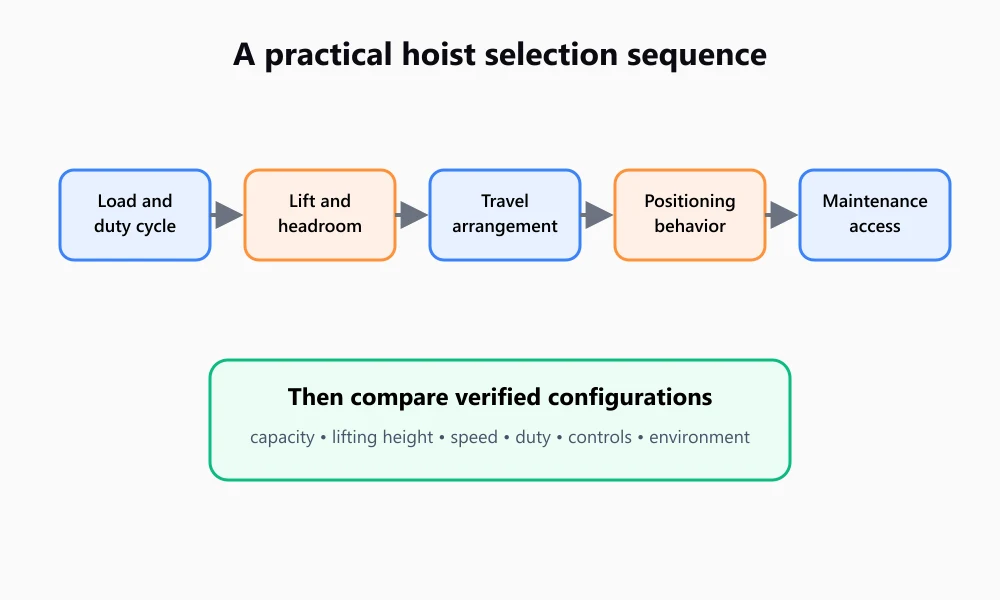
Add maintenance constraints, including safe access, component removal, shutdown limits, and spare parts. Name any applicable local or plant rules.
Choose the configuration that satisfies the lifting task, fits the space, integrates with the trolley and controls, and remains inspectable. To request a KUANGYUAN review, send the project data with load, lift height, duty cycle, headroom, travel, power supply, and site drawings.
No. Product families overlap, and rated capacity alone does not define suitability. Confirm the exact model, duty assumptions, lifting height, trolley arrangement, and environment from verified technical data.
No. The full installation envelope includes the body, trolley, hook approach, chain container, controls, and service clearance. Compare approved dimensional drawings for the actual configuration.
They share general items such as brakes, hooks, limits, controls, and trolley components, but the lifting-medium checks differ. Wire rope systems require rope, drum, guide, sheave, and reeving checks. Chain systems require load-chain, pocket-wheel, guide, and chain-container checks.
Leave capacity, speed, duty class, power, protection rating, temperature range, and dimensions blank until a registered source or verified model sheet supports the values.
 Whatsapp