Welcome to Henan Mine Crane Co.,Ltd.
Every cross-border Crane order needs an equipment scope and destination compliance route. Put the design standards, inspection stages, and handover documents in the specification. They define production, inspection, and delivery.

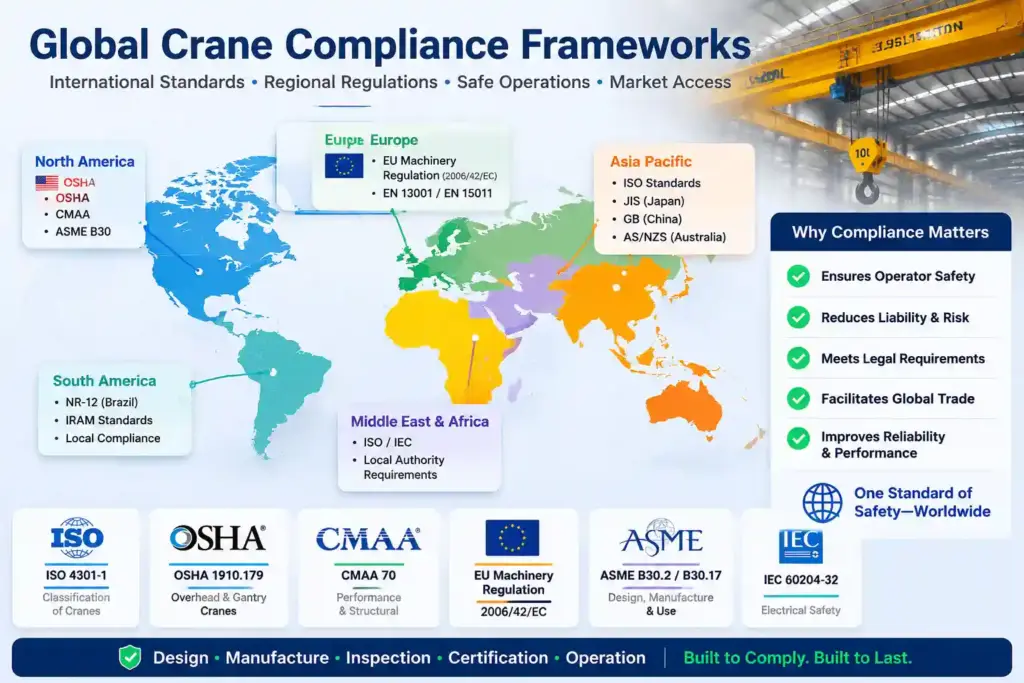
International compliance combines legal duties, technical standards, conformity documents, and inspection records. The law governs market access and workplace duties. Standards guide the engineering. Documents record evidence for the ordered crane.
The installation country sets the legal starting point. Check the authorities for machinery, workplace safety, electrical systems, and hazardous areas. Put the duties of the importer, owner, employer, installer, and manufacturer in the compliance matrix before contract award.
Design standards cover strength, loads, mechanisms, brakes, controls, limit devices, access, and duty classification. Manufacturing specifications set records for materials, welding, NDT, electrical work, coating, and dimensions. Safe-use standards govern inspection and maintenance after commissioning.
Read each document by title and scope. An inspection report states what a competent inspector examined. A test certificate records a defined test and result. A declaration identifies the conformity route. Third-party verification covers its stated work.
Destination, crane type, application, and contract determine the standards. Confirm each edition during RFQ and design approval. Use the crane product categories to define the equipment scope.
| Market or project | Framework to check | Buyer evidence |
| International or multi-country | ISO and project specifications | Standards register, design basis, inspection plan |
| United States | OSHA, applicable ASME B30 and CMAA specifications | Design declaration, inspections, test report |
| European Union | EU legislation, harmonised standards, conformity route | Declaration, risk assessment, technical file |
| United Kingdom | UK product rules and PUWER/LOLER | Market documents, examination report |
| Australia, Canada, or regulated sectors | National, local, site, and sector rules | Jurisdiction review, registrations, competent-person records |
ISO 4301 deals with crane classification. ISO 9927-1 covers general inspection requirements. Check current editions, amendments, and national adoptions in the ISO catalogue, then record them in the contract. Projects may also use FEM, DIN, client practices, or classification-society rules. Record their precedence.
For US general industry, OSHA 29 CFR 1910.179 requires inspection of new and altered overhead and gantry cranes before initial use. Frequent inspections run from daily to monthly; periodic inspections run from 1 to 12 months. Applicable ASME B30 and CMAA specifications add technical and maintenance criteria. CMAA Specification 78 covers personnel qualifications and training.
For an EU order, use the legislation in force when the machinery enters the market. Regulation (EU) 2023/1230 applies from 14 January 2027. Check the conformity route, risk assessment, technical file, declaration, instructions, and marking against the supplied assembly.
UK LOLER requires a competent person to conduct the thorough examination and issue a written report. HSE guidance sets six months for equipment lifting people and lifting accessories, and 12 months for other lifting equipment. A written examination scheme may set another interval.
Australia and Canada combine national standards with state, territory, or provincial duties. Location determines registration, inspection, engineer sign-off, and operator requirements. Sector rules cover regulated applications. Get the final list in writing from the authority, owner, or qualified adviser.
Begin the audit with the proposed crane. Give the supplier the destination, lifting task, operating environment, and crane application requirements. Select production records that match the order's required dossier.
The design basis states capacity, span, lifting height, runway interface, power, controls, speeds, load spectrum, cycles, and duty class. Site data covers temperature, dust, humidity, corrosion, wind, seismic conditions, and hazardous-area classification. Include attachments and personnel-lifting restrictions. Record the classification method and standard edition; A-class, FEM, and ISO labels require engineering review.
Approved drawings should flow into purchasing, fabrication, assembly, and testing. Follow one component through its material certificate, heat number, weld map, NDT report, dimensions, and final inspection. Review electrical tests, coating reports, torque records, and instrument calibration where applicable.
Start with the scope field. Record the issuer, accreditation, manufacturer, address, model, serial number, standard edition, dates, and exclusions. Confirm market-access and shipment-release documents with the issuer. State whether each document covers a component, management system, model, or complete crane.
Attach the inspection and test plan to the order. Name the performer, witness, record, and release authority for each activity. At a hold point, production resumes after written approval.
| Stage | Typical hold or witness point | Required record |
| Design | Design basis, calculations, drawings, safety functions | Approved document register and comment closure |
| Materials and fabrication | Main steel, welding, NDT, dimensions | Certificates, traceability map, inspection reports |
| Factory acceptance | Functional checks, brakes, limits, controls, electrical tests | FAT procedure, measured results, punch list |
| Load test and shipment | Agreed test load, deflection or performance checks, packing release | Signed test report, defect closure, release note |
| Site acceptance | Installation, runway interface, commissioning, operator handover | SAT report, as-built dossier, examination or permit records |
Design approval is usually the first hold point. Critical materials, welding procedures, and shipment release can follow. State the notice period and acceptance criteria for each. Give third-party inspectors the approved drawings, standards, procedures, and concessions.
During FAT, exercise the specified motions, brakes, controls, interlocks, limits, alarms, and emergency functions. Record the measurements. Load testing follows the applicable law, standard, manufacturer instructions, and approved procedure. OSHA 1910.179 limits rated-load test loads to 125% unless the manufacturer recommends otherwise; reports remain on file. Close each defect with repair and retest records.
Site acceptance covers installation geometry, runway and power interfaces, settings, safety devices, access, signage, and delivered documents. Name the competent person or authority for the pre-use inspection. Set maintenance, operator checks, training records, inspection intervals, and report retention before operational release.
The RFQ should state the destination, project data, duty, environment, interfaces, and safety functions. Add regulations, standard editions, document precedence, the inspection plan, language, and approval schedule. Use a register for required drawings, calculations, procedures, certificates, declarations, manuals, and as-built records.
At handover, work through the register line by line. The file may include approved drawings, calculations, material and welding records, NDT and electrical reports, software backups, FAT and load-test reports, calibration, defect closure, market documents, manuals, spare-parts lists, training, and as-built files. Match model and serial numbers to the nameplate.
A complete Crane compliance package runs from destination law to the accepted handover file. The contract fixes technical standards, design inputs, manufacturing evidence, inspection hold points, document editions, and responsibilities. Review the evidence at each release stage.
KUANGYUAN is a crane brand of Henan Mine Crane Co., Ltd. Its scope includes overhead cranes, gantry cranes, hoists, winches, jib cranes, transfer carts, and project-specific handling equipment. The Henan Mine Crane company profile gives current company details.
For a technical proposal, submit your crane project requirements with capacity, span, lifting height, duty class, power, controls, environment, destination, standards, inspection points, and required documents.
Q1: Which international crane standards should a buyer specify?
A: Begin with destination-country law. Add standards for the crane type, duty, application, electrical system, and site. Put editions and document precedence in the RFQ.
Q2: Is ISO 9001 enough to prove that a crane complies with local law?
A: ISO 9001 covers the manufacturer's quality-management system. An ordered crane needs evidence tied to applicable law, technical standards, conformity documents, inspections, and tests.
Q3: What documents should be checked before a crane leaves the factory?
A: Use the approved document register. Check drawings, traceability, welding and NDT records, electrical reports, FAT and load-test results, defect closure, market documents, manuals, and shipment release.
Q4: Does every crane need a 125% load test?
A: Applicable law, standards, manufacturer instructions, and the approved procedure set the test load. OSHA 1910.179 caps it at 125% unless the manufacturer recommends another value.
Q5: How often must an overhead crane be inspected?
A: Jurisdiction, service, crane condition, and inspection category determine the interval. Under OSHA's regular-service schedule, frequent inspections run from daily to monthly, while periodic inspections run from 1 to 12 months.
 Whatsapp