Welcome to Henan Mine Crane Co.,Ltd.
Picture this. A loaded hook is hanging at 12 meters. The operator hits stop. What happens next — that fraction of a second — is everything the brake does in one movement. It catches the load. Then it holds it. Then it waits for the next command. Simple? On paper, yes. On a real jobsite with a real load and a brake that's been running for three years straight? That's where the engineering matters.
Here's the thing most people get wrong about hoist brakes. They think mechanical and electromagnetic are two competing designs. They're not. They're two halves of the same assembly. One provides the force. The other controls when that force applies and when it lets go. Pull the manual for your specific model before you touch anything — a torque spec from a different hoist is worse than useless, it's dangerous.
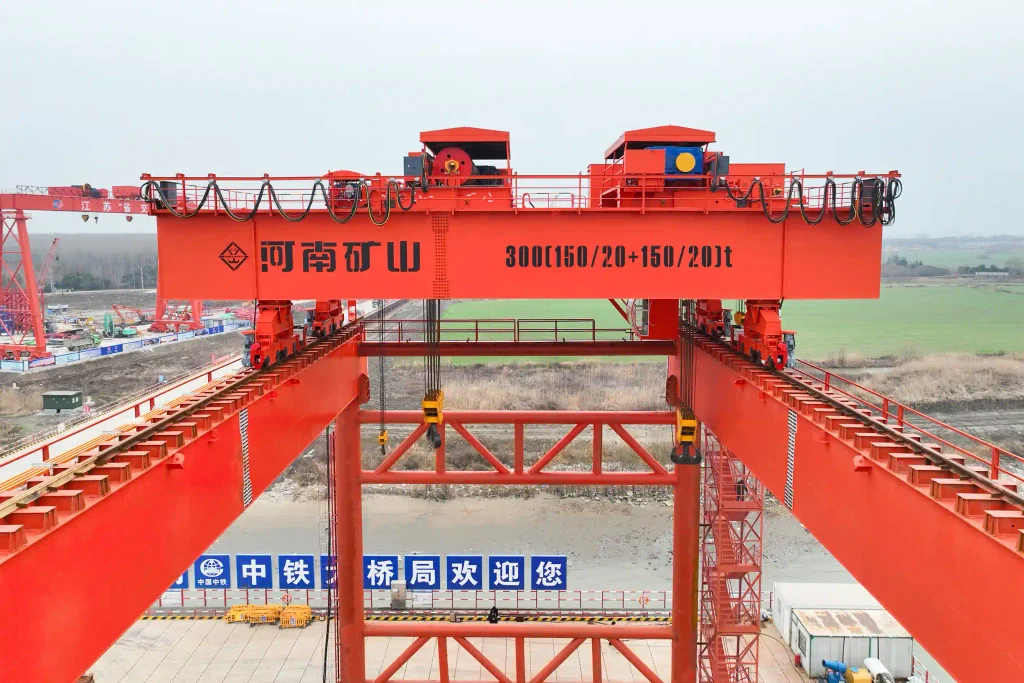
You'd think they're the same. They're not. And the distinction matters more than most operators realize.
Stopping means the brake absorbs the energy of motion and brings the load to rest. Holding means the brake keeps the load stationary after motion has ended — possibly for hours, possibly overnight, possibly through a full shift change. These two jobs stress the brake differently. A brake that stops an empty hook cleanly can still drift under a full rated load. We've seen it. The operator reports "brake works fine," and then someone walks underneath a loaded hook that's slowly creeping downward.
So what does the brake actually do across the full lifting cycle? It engages when the operator commands a stop. It engages when the drive changes state — direction reversal, speed step-down, emergency off. It holds the load during idle periods. And it engages by default when power is cut or lost. The control sequence built into the hoist determines how smoothly each transition happens and how much load movement you'll see during a stop. That's why two hoists with the same brake hardware can behave differently — the control logic is different.
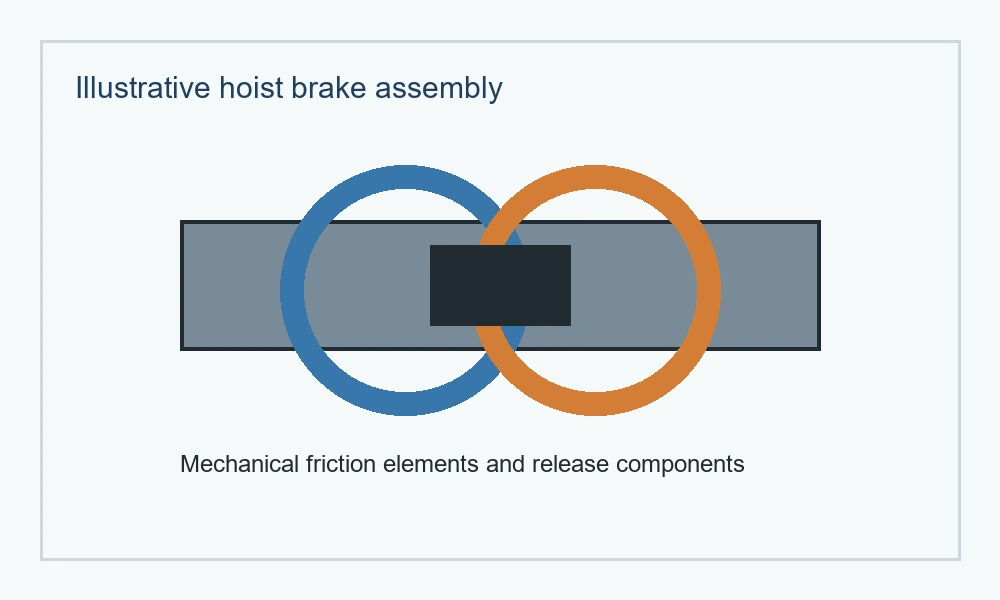
Let's walk through what's actually in there. A mechanical brake on a typical electric hoist uses — at minimum — a disc or drum, friction linings, a hub, springs (and they're strong), an armature plate, a release mechanism, and a set of fasteners holding the whole stack aligned. That friction surface you can see through the inspection cover? That's one component. Not the whole story.
When you do a visual inspection, here's what to look for — and this list comes from years of field experience, not a textbook:
Wear on the friction surfaces. Is it even, or is one side doing more work than the other? Uneven wear means a mechanical problem elsewhere — alignment, spring force distribution, or a warped disc.
Contamination. Oil, grease, water, dust. Any of these on the friction surface changes the coefficient of friction. And changed friction means changed stopping distance. If you see contamination, find the source before you clean and reassemble.
Scoring or heat marks. Scoring means something harder than the lining got between the surfaces. Heat marks (blueing, discoloration) mean the brake was dragging — engaging partially while the hoist was running. Both conditions need investigation, not just cleaning.
Loose hardware. This one gets missed a lot. Springs apply force through fasteners. If a bolt backs off even slightly, the force distribution changes. Check torque on the fasteners that hold the brake stack together, not just the external ones.
Damaged wiring at the release assembly. The electromagnetic release mechanism has wiring going to it. Vibration, heat cycling, and aging insulation can break or short this wiring. If you're chasing a brake problem and haven't checked the wiring path to the release coil, start there.
Now — here's the part where a lot of maintenance programs go wrong. Someone grabs a friction-brake spec sheet from the internet, finds a lining thickness number, and applies it to every hoist in the facility. That number is meaningless outside the context of the specific brake model. Lining thickness minimum, spring force, air gap, rated torque, replacement intervals — all of these come from the manufacturer's documentation for your specific assembly. If that document is missing? Stop. Request it. Don't guess. A guessed air gap is how you get a brake that either drags (too tight) or slips (too loose).
OK so the mechanical brake is spring-applied. That means by default, the brake is ON. The springs push the friction surfaces together. To make the hoist move, you need to release the brake — and that's where the electromagnetic part comes in.
A coil gets energized. The magnetic field pulls the armature plate against the spring force. The friction surfaces separate. The hoist can move. When the control signal is removed, the coil de-energizes, the springs push back, and the brake applies. That's the cycle. It happens fast — typically in tens to hundreds of milliseconds — and it has to be coordinated with the motor drive. Release too early and the motor drives against a brake that's still partially engaged. Release too late and the load drops before the brake lets go.
The practical question when you're troubleshooting is always the same: does the brake change state at the right time, and does it return to its holding condition the moment the release signal drops? A delayed release shows up as noise, heat, or jerky starts. A delayed application shows up as the load drifting after the stop command. Both of these conditions point to a problem somewhere in the coil-rectifier-contactor-wiring chain — or in the mechanical release mechanism itself. Symptoms cross over. An electrical problem can look mechanical. A mechanical problem can look electrical. You have to follow the manufacturer's troubleshooting sequence, not jump to conclusions.
Here's how to narrow it down. The coil, the rectifier (if fitted), the contactor, the control wiring, and the mechanical release linkage all need to be checked as a system — not one at a time. A symptom that looks like a worn friction surface might actually be a failing rectifier that's delivering partial voltage to the coil. And the reverse: what looks like an electrical fault could be a sticky armature that's binding because of contamination. If you want to see how the brake arrangement fits within the broader hoist design, compare it against the approved electric hoist range and the European electric hoist configuration for your model. But the controlling document is always the model-specific manual — not the catalog, not the website, not what the guy at the next facility told you.
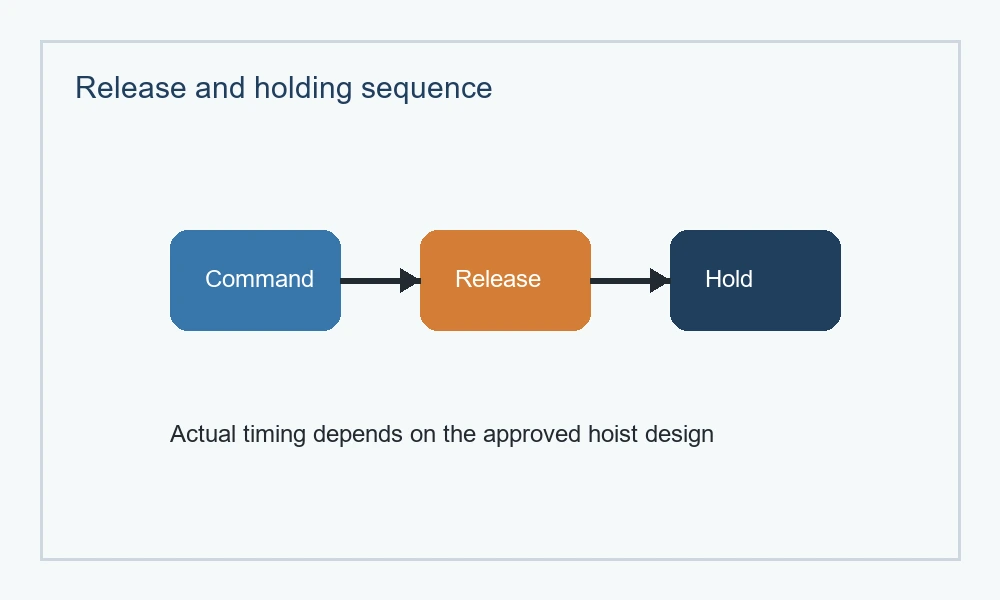
The brake doesn't exist in isolation. It's part of a control system, and that system defines how the brake responds during start, stop, direction change, and — the big one — loss of power.
Most electric hoists use a spring-applied, electrically released brake. That means: power on, brake releases. Power off, brake applies. It's fail-safe by design. If the building loses power, the brake engages. The load stays where it is. That's the theory.
But here's what the theory doesn't cover. Some systems add monitoring circuits. Some have time delays built into the control sequence. Some use a different brake topology altogether — two brakes, one on the motor shaft and one on the load path. You cannot look at a hoist in one facility and assume the next one behaves the same way, even if they're the same brand. Revisions happen. Control boards get updated. Options get added. The manual for that specific serial number is the only reliable source.
Before any functional test, make sure of three things. One: the test area is barricaded and no one is under the load. Two: the load and hook path are clear of obstructions. Three: the test method matches what your site procedure requires — not what seems reasonable, what the procedure says. Then watch what happens. Does the brake release fully before the motor tries to lift? Does it apply without an abnormal delay when the stop command is given? Does it hold the load steady when the command is removed? Write down what you observed, the conditions, and any alarm or fault code. If you can't complete the test safely, document that too. An incomplete test is not a pass — it's an open item.
Power-loss behavior. This gets its own paragraph because it's that important. Your inspection record should state exactly what the approved instructions require for the power-loss test and exactly what was observed during the authorized test. Don't write "brake holds on power loss" — that's a conclusion, not evidence. Write what you did, what the load did, how long you observed, and what the manual says should happen. If what you observed doesn't match what the manual says? Isolate the equipment per your site rules and get a qualified person to assess it before any further lifting. This is not a situation where "close enough" is acceptable.
Let's build a practical checklist. Not the kind that's a generic bullet list — the kind that actually connects what you see on the brake with the evidence that someone has been maintaining it properly.
Start with identity. Hoist model. Brake assembly part number if it's on the nameplate. Serial or asset number. And the current manual revision — because manufacturers update these, and the torque spec you used last year might have been superseded.
Then the mechanical condition. Friction surfaces — thickness, wear pattern, contamination. Springs — are they intact? Is the free length within spec? Armature movement — does it move freely when the release is actuated, or is there binding? Fasteners — torqued to spec or just "snug"? Guards — in place and undamaged? Signs of overheating — blueing, discoloration, melted grease?
Then the electrical release path. Coil resistance (compare to spec). Rectifier output voltage if fitted. Control wiring — insulation condition, connector tightness. The release signal — does the control circuit actually deliver it at the right time?
Then the operating response. What did the brake do during release? During stop? During holding? During the authorized power-loss test? Record the conditions and the observations. Not your interpretation — what you saw.
Then the adjustment evidence. If an air gap was measured, what was the reading? What instrument was used? What does the manual say the range is? Where in the range does the reading fall? If you can't answer these questions from the maintenance record, the adjustment wasn't properly documented — fix the process.
And here's one that gets skipped constantly. If you measure an air gap or any other setting, the record needs the source. Which document did the limit come from? What revision? What's the unit? What was the measurement condition — cold brake, warm brake, after how many cycles? A number without its context is not a maintenance record. It's a guess on paper.
There are conditions where you stop the hoist and escalate. Not maybe. Not "let's try one more lift." Stop. These conditions include unexpected load drift after a stop command. A stop that takes noticeably longer than it did last week. Brake noise that wasn't there before — grinding, squealing, humming. Excessive heat (you can smell it, or the paint is discoloring). Visible damage to any brake component. Any alarm or fault indication on the control panel. Any change in behavior under a test condition that was previously normal.
The operator should follow the site's isolation and reporting process. This is not bureaucracy — it's how you prevent a small problem from becoming a dropped load. And here's the part that matters: a brake fault does not get cleared by repeating the lift until the symptom disappears. A temporary adjustment does not get treated as a permanent repair. We've seen both of these in the field. The outcome is always the same — it works until it doesn't, and then it doesn't catastrophically.
The service decision should pull together the hoist manual, the brake manufacturer's documentation, the inspection history, and the actual symptom description. Not a vague "brake not working" — the specific operating condition, the load, the speed, what the operator observed. This evidence is what lets a competent person separate a worn friction component from a control circuit problem. After corrective work, repeat the required functional checks. Record the results. Then make the return-to-service decision based on evidence, not on schedule pressure.
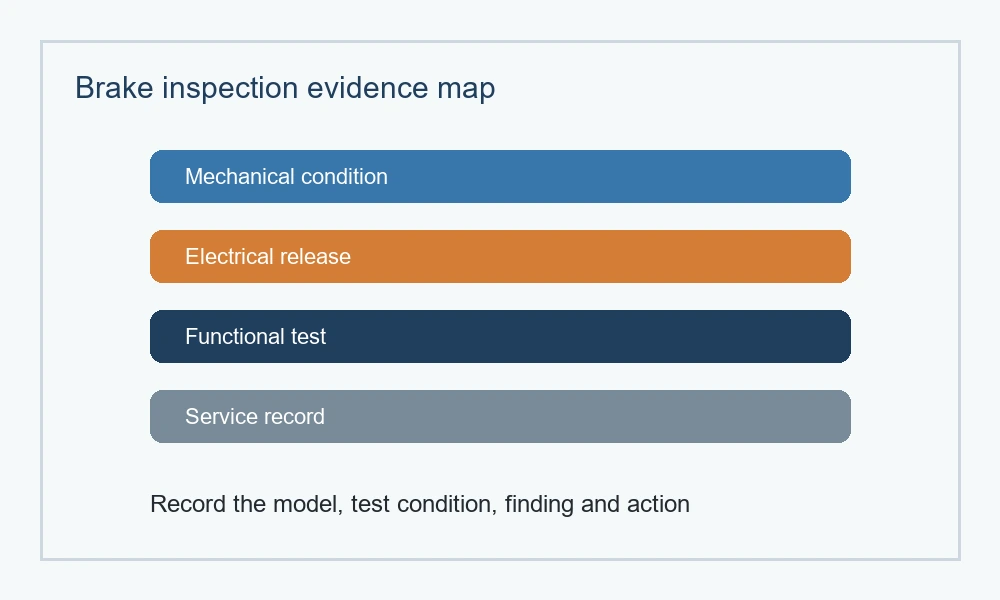
Say you need to send the brake issue out for review — to the manufacturer, to a service partner, to your engineering team. What do they need?
They need: the hoist model and asset identification. The brake type if it's identified on the assembly or in the records. Control voltage information from the approved documentation (not from the nameplate alone — the nameplate tells you rated voltage, not necessarily the control circuit voltage). Recent inspection records — the last two or three, not just the most recent one. And a clear, specific description of when the symptom occurs. Not "sometimes" — under what load, what speed, what command, after how many cycles.
Photos help. A photo of wear or contamination is worth a paragraph of description. But a photo doesn't replace a measurement or a controlled test. If you send photos without measurements, you're asking the reviewer to guess. They can't help you from a guess.
Equipment selection plays into inspection planning too. If you're working with a low-headroom electric hoist, the lifting space and the hoist arrangement interact in ways that affect how the brake is accessed and inspected. And if you have a model-specific brake question — the kind that needs the manufacturer's input — share the hoist model, brake type, and observed symptom through the KUANGYUAN contact page. That gives the reviewer enough to match your situation to the right documents and service data, instead of starting from scratch.
Depends on what you mean by "different." They're different functions within the same brake. The mechanical side — springs, friction surfaces, the hub — that's what holds the load. The electromagnetic side — the coil, the armature, the release mechanism — that's what releases the mechanical brake when the control system says "go." One hoist uses both. They're not alternatives. They're partners.
If the approved procedure authorizes it and you're the qualified person assigned to that task — yes. The correct value, the method, the tolerance, the tools — all of that is specific to the installed brake. If you don't have the document? You stop. You obtain it. You don't adjust based on what seems reasonable. An air gap that's off by a fraction of a millimeter changes the brake torque.
Stop the operation. Secure the area — meaning barricade it, not just walk away and hope no one goes near. Follow your site's isolation and reporting process. Get a qualified inspection before any further lifting. And don't authorize continued use based on a no-load test that looked OK. A no-load test tells you the brake can stop an empty hook. It tells you nothing about what happens under load.
The hoist model and asset ID. The brake or control information you have in the records (if the brake has a nameplate, photograph it). The operating condition when the symptom appears — load, speed, command, cycle count if available. The last two or three inspection reports. And any authorized test results. Give the reviewer context, not just a symptom. Context is what turns a guess into a diagnosis.
Bottom line. A hoist brake is judged by three things: what the approved documents say it should do, what the physical inspection shows, and what the functional test proves. Mechanical friction and electromagnetic release are one system. They work together or they fail together. When the manuals, the inspection records, and the test results all line up, the maintenance team can make a clear call — adjust, repair, or investigate further. When they don't line up, you stop lifting until they do.
 Whatsapp