Welcome to Henan Mine Crane Co.,Ltd.
Buying an Overhead Crane directly from a Chinese manufacturer gives you closer access to specifications, configuration, inspection records, export packing, and quotation scope. A clear purchase order turns that access into project control. Compare offers against the same technical data, supply boundaries, and acceptance requirements.
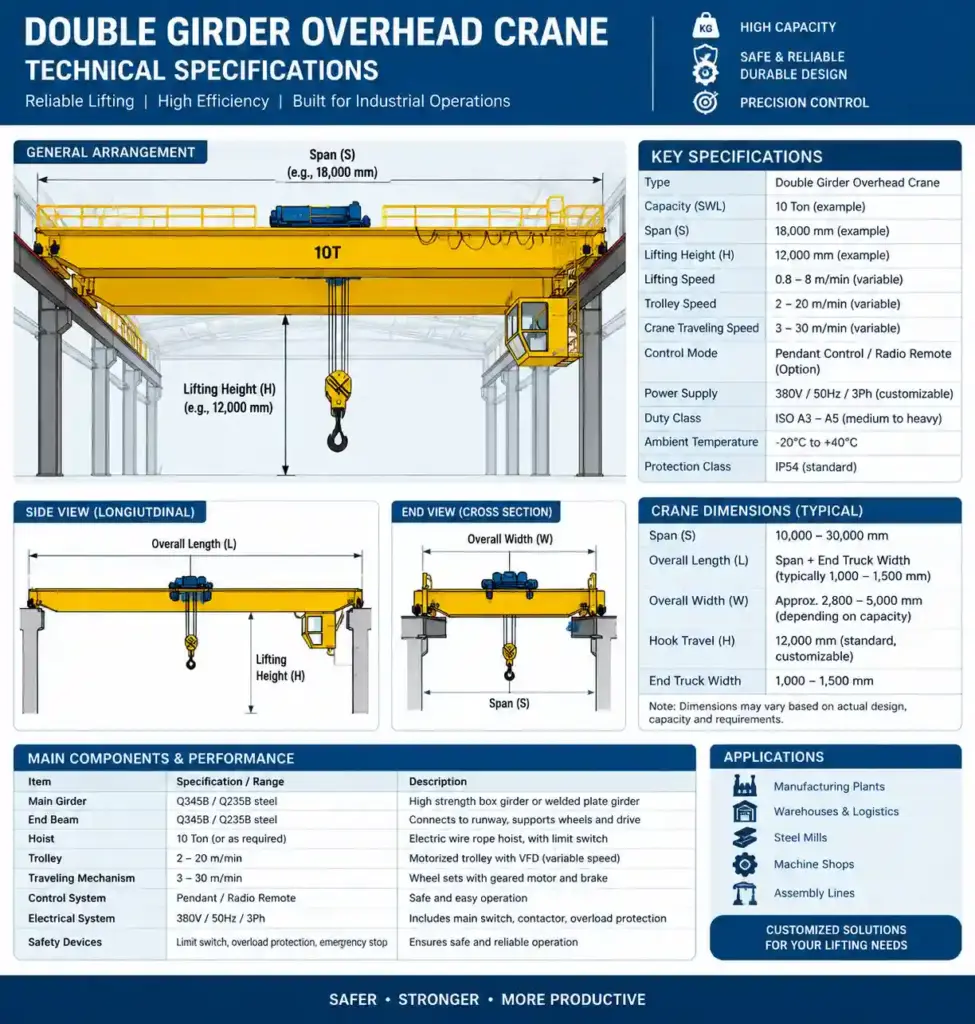
Infrastructure and industrial projects often need equipment built around the workshop, runway, power supply, and lifting task. Factory-direct sourcing connects your project team with the people preparing the crane design, drawings, production records, and test plan. Use the crane application requirements to define that work.
The route suits projects with defined engineering inputs and import responsibilities. Typical settings include workshops, steel facilities, power projects, mines, precast yards, and logistics buildings. Each setting changes the duty, attachment, environment, and interfaces.
The contract should name the manufacturer, engineering contact, production site, inspection access, documents, payment stages, Incoterm, and warranty party. Assign responsibility for the runway, power feed, unloading, erection, commissioning, and permits. These terms define the direct relationship.
Direct communication puts your site data into the quotation and drawings. A structured data sheet gives every supplier the same basis and exposes technical deviations before award.
State rated capacity, span, lifting height, headroom, hook approach, runway length, speeds, load form, attachment, cycles, and duty class. Capacity alone leaves the bridge crane duty undefined. Maintenance lifting and repeated production cycles create different design bases.
Record voltage, frequency, phases, controls, temperature, humidity, dust, corrosion, wind, and hazardous-area classification. Add clearances, runway-beam data, rails, and maintenance access. Prepare one signed project data sheet and require the technical proposal to reference it.
Chinese manufacturers organise overhead cranes into standard families and project-specific versions. Match that range to the lifting task and site limits, then review the overhead crane product range.
| Project condition | Configuration to review | Buyer input that drives the choice |
| Workshop duty | Single-girder crane | Capacity, span, lift, cycles, headroom |
| Higher duty or load | Double-girder crane | Load spectrum, speeds, maintenance space |
| Low clearance | Compact arrangement | Roof level, runway elevation, hook approach |
| Dust, gas, heat, or molten metal | Special-purpose crane | Hazard class, temperature, material |
| Bulk or steel handling | Grab, magnet, or spreader | Load form, attachment, controls |
Single-girder cranes serve many light- and medium-duty workshop tasks. Double-girder cranes address higher duty, larger loads, wider spans, greater hook height, or added maintenance access. Headroom and building loads can decide the choice. Review current single girder overhead crane options during initial selection.
Explosion-proof, metallurgical, foundry, grab, electromagnetic, suspension, and double-trolley cranes address defined conditions. Your RFQ should state the load, environment, operating sequence, safety devices, and destination rules. The proposal can then identify the applicable configuration.
Direct sourcing gives your team access to the engineering review. The manufacturer can address comments on the general arrangement, mechanisms, electrical diagrams, runway reactions, wheel loads, and controls. A document register identifies the accepted production revision.
Start with the general arrangement and interface loads. Check span, hook approaches, clearances, runway elevation, conductor system, controls, and access. Close every comment against a revised drawing. The approved drawing should match the purchase order model, capacity, and project reference.
The order can require material records, welding qualifications, NDT reports, electrical checks, dimensional inspection, factory acceptance testing (FAT), applicable load-test records, defect closure, and manuals. Define hold and witness points before production. The inspector then follows the agreed plan.
A factory quotation can show equipment and service boundaries in detail. Give every bidder the same scope, request a line-by-line schedule, and record each exclusion.
| Cost or scope item | Question for the quotation | Evidence to request |
| Crane equipment | Which bridge, hoist, controls, electrics, and accessories are included? | Itemised technical offer |
| Packing and freight | What packing, shipping split, port, and Incoterm apply? | Packing plan and freight basis |
| Destination charges | Who covers duties, taxes, port handling, and inland transport? | Buyer cost worksheet |
| Installation | Who supplies labour, tools, lifting equipment, travel, and accommodation? | Responsibility matrix |
| Acceptance and support | Which tests, documents, spares, training, and warranty terms apply? | Contract schedule |
Compare the crane, hoist or trolley, electrics, conductor system, controls, safety devices, rails, spares, tools, documents, packing, and support. Match the Incoterm and destination. Place the local-work responsibility matrix beside the price sheet.
Your landed-cost worksheet covers equipment, packing, freight, insurance, duties, taxes, port charges, inland transport, unloading, storage, erection, electrical connection, testing, and approvals. Use current quotations so procurement and engineering share one cost basis.
Factory-direct planning connects crane design to the shipping split. Girder length, freight limits, road access, port handling, and site lifting capacity affect packing and assembly. Record the split on drawings and packing lists.
Request package dimensions, weights, lifting points, markings, preservation, and a packing list tied to the bill of materials. Site teams can plan unloading, lifting equipment, storage, and assembly. Include pre-closing package photos in the inspection plan for receipt checks.
Installation readiness covers runway, rails, power, access equipment, lifting plan, labour, tools, supervision, commissioning, and local inspection. Assign each item to the manufacturer, buyer, contractor, or authority. Close open interfaces before shipment.
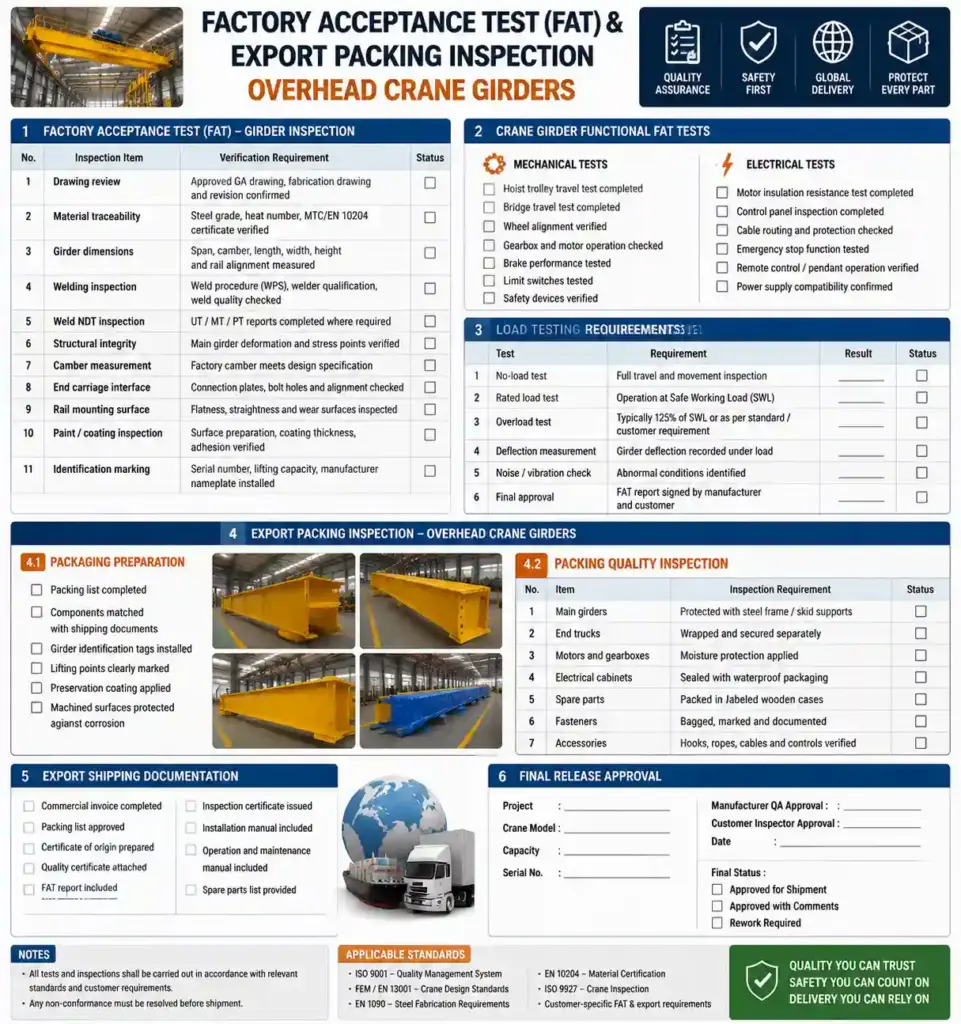
Verify the supplier against the proposed crane and contract. Review the contracting entity, production address, technical team, comparable records, drawing process, manufacturing controls, test capability, and document samples. Certificate checks cover issuer, standard, edition, manufacturer, model scope, dates, and validity.
Ask the supplier to trace one main component from purchase through final inspection. Review material identity, welding records, NDT, dimensions, electrical tests, and calibration. Comparable drawings and FAT reports show the expected dossier detail.
Hold points can cover design approval, critical materials, welding procedures, FAT, required load testing, defect closure, packing, and shipment release. State the notice period, acceptance criteria, responsible party, and record. Inspection then becomes a contract process.
Direct sourcing creates value through consistent specifications, suitable configurations, approved drawings, defined inspections, commercial scope, and shipping plans. Carry each requirement into the contract and handover file.
KUANGYUAN is a crane brand of Henan Mine Crane Co., Ltd. Its scope covers single-girder, double-girder, suspension, explosion-proof, metallurgical, grab, electromagnetic, foundry, and other overhead-crane configurations. For a technical proposal, submit your overhead crane requirements with capacity, span, lifting height, duty, power, controls, environment, destination, shipping scope, inspection points, and documents.
Q1: Is buying an Overhead Crane directly from China always cheaper?
A: A factory-direct route can remove an intermediary commercial layer. Compare complete landed and installed costs because freight, taxes, inland transport, erection, and local approval remain project-specific.
Q2: What specifications should you send to a Chinese Bridge Crane manufacturer?
A: Send capacity, span, lifting height, headroom, duty, cycles, speeds, power, controls, load form, attachment, environment, runway data, destination, standards, and acceptance requirements. Use one controlled data sheet for every bidder.
Q3: Should you choose a single-girder or double-girder overhead crane?
A: The choice depends on capacity, span, duty, headroom, hook height, building loads, and maintenance space. Ask the manufacturer to show these effects in the general arrangement and technical offer.
Q4: How can you verify a Chinese overhead crane manufacturer?
A: Verify the contracting entity and production address, then review comparable drawings, traceability records, manufacturing procedures, inspection capability, FAT documents, and certificate scope. Put the agreed checks in the purchase order.
Q5: Which documents should be approved before shipment?
A: Approve the final drawings, inspection and test records, FAT and load-test reports where required, defect closure, packing list, manuals, electrical diagrams, spare-parts list, declarations or market-access records, and shipment release.
 Whatsapp